
Wondering how to balance hormones naturally? Personally, I have struggled with this for a long time. I suffered from hormonal acne for years and had visited various doctors and none of them had any input for me on how to deal with my problems.
So I started reading a lot about the topic. One by one, I implemented changes in my life to get my hormones back to balance. Today, my acne is under control and I feel better than I have in a long time. (For a list of 6 actionable steps I took, read my post about how I beat hormonal acne.)
For that reason, I want to share the things I learned about how to balance hormones naturally.
We will talk about
- What hormonal imbalance in women is
- The causes of hormonal imbalance in females
- Common hormone imbalance symptoms
- How to get your hormones checked for imbalances and, of course,
- How to balance hormones naturally
I hope this will help some people as it helped me.
That being said, I am no doctor. All the things written here are to the best of my knowledge, but none of the content provided in this blog, and in any linked materials, is intended or should be construed as medical advice. If a reader or any other person has a medical concern, he or she should consult with an appropriately-licensed physician.
Related: Being vulnerable: My painful struggle with hormonal acne
Related: I beat hormonal acne: My 6 powerful little secrets
Disclosure: Some of the links below are so-called provision links, meaning, at no additional cost to you, I can earn a commission if you click through and make a purchase.
What is hormonal imbalance in women?
So what is hormonal imbalance? Many people think of hormones as “that stuff that makes teenagers wild”. But hormones are so much more than that.
What hormones do in our bodies
Actually, they are responsible for thousands of tasks in our bodies. Hormones are responsible for how we feel, for the quality of our sleep, regulating blood sugar levels, our immune system, and even cell growth. It is safe to say that in everything you do or feel, those little chemicals play a part.
The simple answer to “What is hormonal imbalance?”
In order to deal with that many tasks, the human body uses about 50 different hormones, created in various glands all over the body. (See the infographic for details.)
And they not only affect you in pretty much anything, but they can also strongly affect each other. This can change the “perfect” hormones ratio to a less desirable one. It really is as simple as this. This is what hormonal imbalance is.

Now there are no hormones that are generally good or bad.
Especially when it comes to hormonal imbalance in women, there are misconceptions.
We often read about a lady having too much of a male hormone. This can create the impression that women shouldn’t have those. Instead, the opposite is true. Male hormones like testosterone play a very important role in the female body as well.
In fact, one extremely common female hormone imbalance is estrogen dominance. This means there is too much estrogen (THE female hormone) in relation to other hormones.
In a nutshell: We need all hormones, both male and female. What matters, is how to balance those hormones naturally.
Causes of hormonal imbalance in females
There are many causes of hormonal imbalance in females. As explained above, we have a big variety of chemicals in our body. All of them interact with each other and we influence them with what we eat, do and even think!
Still, there are some reasons for hormonal imbalance that are more common than others in today’s world. Let’s have a look at those.
Common causes of hormonal imbalance in females
1. Stress

Many people know that there is such a thing as a “stress hormone”, also known as cortisol. When we are stressed, our body gets flooded with cortisol.
Now you might wonder why your body has this built-in function if cortisol is not good for it. Again, there are no bad hormones.
Cortisol is vital for many important body functions. It regulates metabolism, blood pressure, and blood sugar levels, reduces inflammation and helps with our memory, to just name a few.
Related: 13 super effective stress relief activities (no gadgets)
But when there is too much stress, the body starts using up progesterone to make more cortisol. So now there is not enough progesterone. Which again has an effect on other hormones… And there we go, our hormones are out of balance and the chain reaction starts.
Related: 10 practical things to put in a Stress Relief Goodie Bag
2. (Natural) Hormonal changes
Puberty, pregnancy, and menopause. While those stages of life are all natural, they seriously impact our body chemistry and its’ balance. All of these make hormone balance for women challenging at times.
At least two of those are unavoidable causes of hormonal imbalance in females. In puberty new hormones join the party. In pregnancy, our bodies create a very different hormone-cocktail than usual to grow new life. And in menopause, some chemicals just leave the mix.
3. Illnesses, Disorders, Tumors
As our body is a very detailed and finely tuned machine, any changes or “defects” in it affects our hormonal balance as well. So if any of our hormone-producing organs gets sick, we have another chain reaction of hormones doing all the wrong things at hand.
A typical example is hypo- or hyperthyroidism (or under- or overactive thyroid). But also tumors and diabetes will greatly change the hormonal balance.
4. Diet

As you can see in the infographic above, many of our digestive organs do work themselves when it comes to producing hormones. So it shouldn’t come as a surprise that our diet can be a huge factor when it comes to hormonal imbalance. Very generally speaking, there are three main ways in which our nutrition can throw us off balance hormonally:
- We eat food that badly influences internal hormone production. For example, a diet that regularly provokes huge insulin spikes. High insulin levels, in turn, can cause the ovaries to make too many androgen hormones. And this can definitely cause trouble for females!
- We consume food that already contains hormones, thereby sending confusing signals to our body. From cow milk to tofu, many foods contain hormones. And while so-called “phytoestrogens” or plant-based estrogens can help with hormonal imbalance, they can also cause them. Your body could think “Oh, okay, we have enough of this stuff. Let’s just stop producing it, we got enough to do already!”
- We simply don’t eat balanced enough to get all the nutrients our sophisticated body-machine needs. This means it cannot produce all the necessary chemicals in the right balance.
Related: Quick and easy low carb Chai Tea Latte recipe
5. Lack of sleep
While we sleep, our body uses the rest time to level out and organize plenty of things. It metabolizes stress hormones, trains new cells for our immune system, produces melatonin and growth hormone, adjusts reproductive hormones and many more things.
And what do you think happens to those tasks when we don’t get enough shut-eye? Exactly, they don’t happen. Or only very insufficiently. So it is safe to say that sleep is critical for hormonal imbalance.
6. Medication
Last but not least, medication is one of the common causes of hormonal imbalance. Most substances we take as medication can throw our hormones off balance. In many cases, this is the lesser of two evils. After all, medication saves lives!
But there are also cases in which we take pills that might solve an inconvenience, but have very strong effects on our hormones. Yes, I am looking at you, contraceptive pills! Hormone drugs can confuse our natural hormonal production for years, even after not taking them anymore.

Common hormone imbalance symptoms
So what does it look like when you have your hormones out of balance?
There are countless hormone imbalance symptoms. And while they are usually not distinct enough to give a clear diagnosis, it is hard to miss the signs and effects of hormonal imbalance.
Let’s look at some common symptoms of unbalanced hormones a little more in detail.
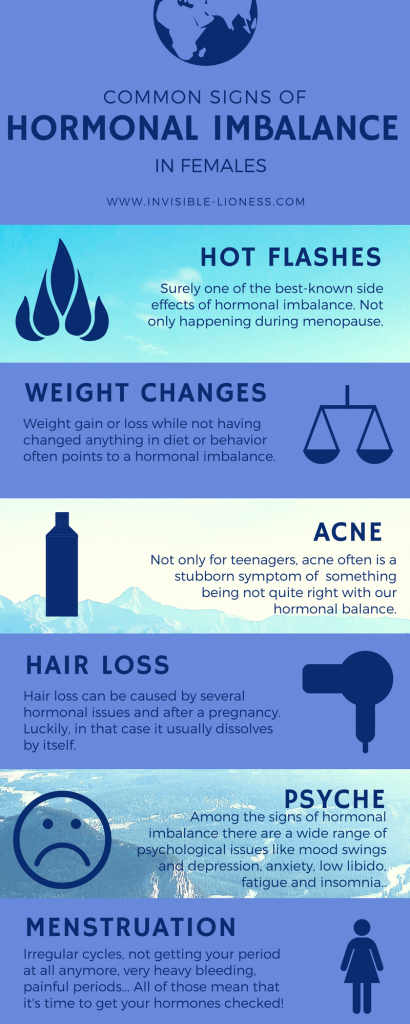
Hormone imbalance symptoms: Hot flashes
Surely one of the best-known side effects of hormonal imbalance. Many people think that hot flashes are only happening during menopause. But anyone with an estrogen dominance has a high chance of experiencing hot flushes as well! So far it is not known what exactly causes them.
Hormone imbalance symptoms: Hormones and weight gain
Weight gain also belongs in the list of the better-known signs of hormonal imbalance. Similar to hot flashes, hormonal weight gain usually comes from an estrogen dominance. High levels of estrogen can lead to higher insulin levels. This makes you store more fat and negatively affects your thyroid and sleep.
All of those factors lead to weight gain. As a result, people suffering from this imbalance, and wanting to lose weight can feel discouraged. It can seem as if it doesn’t matter what they eat. Luckily, that is not true.
Related: How to get rid of water retention
Hormone imbalance symptoms: Hormone imbalance weight loss
The exact opposite, but nevertheless one of the symptoms of unbalanced hormones can be weight loss. Losing weight despite normal to increased appetite and normal calorie intake is usually related to an imbalance of thyroid hormones.
Although sometimes people jokingly say they’d wish to have this problem, weight loss due to hormonal imbalance is no joke. We are not talking losing those few extra pounds here!
This kind of weight loss is a symptom that something is seriously wrong with your hormones. And this along with the accompanying side effects is certainly not desirable.
Hormone imbalance symptoms: Hormonal imbalance acne
Acne is not only one of the signs of hormonal changes like puberty. It can also be a symptom of hormone imbalance during other phases of your life. Hormonal acne is one of the hardest to get rid of, but I can personally vouch for it being possible!
After years of suffering from severe hormonal acne, I finally found out how to balance hormones naturally. My acne was not the only symptom that disappeared, but certainly the most noticeable for friends and colleagues.
Related: How to detox a clogged lymphatic system: 11 easy tricks
Hormone imbalance symptoms: Hormonal imbalance hair loss

Another pretty disheartening signal of a hormone imbalance, not only for people with long hair like me. Additionally, the hair loss due to hormones is easily visible to everyone else. Unfortunately, it can be caused by not only one, but several hormonal issues.
Estrogen dominance, excess testosterone, insulin resistance, and thyroid issues all can lead to hair fall. Hormonal hair loss is also common after a pregnancy. Luckily, in that case, it usually dissolves by itself.
Related: Healthy hair diet: See the best foods for healthy hair!
Hormone imbalance symptoms: Psychological effects
Our hormones don’t only affect our outward appearance. They also have a huge effect on our psyche. So naturally, among the signs and symptoms of hormonal imbalance, there is a wide range of psychological issues. Mood swings and depression, anxiety, low libido, fatigue, and insomnia are common signs that your hormones might be out of balance.
Related: My favorite hack to relieve fatigue – quickly and healthily!
Hormone imbalance symptoms: Menstruation issues
Anything that might be off with your menstruation means that whatever is bothering your body is hormonal. Irregular cycles, not getting your period at all anymore, very heavy bleeding, painful periods… All of those are clear signals that it is time to get your hormones checked!
Related: The amazing health benefits of ginger for menstruation
How to get your hormones checked for imbalances
If you suspect something might be off, go get your hormones checked for imbalances. While you might feel certain about having a specific imbalance after reading things online, don’t rely on that.
Our body and especially our hormones are an incredibly complex system. So make sure you get a proper diagnosis. Even if you read everything there is to read about how to balance hormones naturally. Really!
See a doctor for hormonal imbalance
Your next item on the agenda should be to see a doctor for hormonal imbalance. This doesn’t necessarily have to be a “hormone doctor” right away. The important thing is that you get your hormones checked for imbalances by a professional.
If you have a general physician that you see more or less regularly, it can be a good idea to go there first. Your general physician knows you and your physical state. This could already help a lot with the diagnosis.
If you want to go directly to a doctor, who specializes in conditions related to hormones, visit an endocrinologist. Or if you are having symptoms that are period related, your OBGYN will know what to check.
Get a hormone test done
Once you picked a doctor, the next step will be a hormone imbalance test. There are different types of hormone level tests. Depending on the specific hormones the doctor will have you take a saliva or blood/serum test.
While there are various hormone level tests available online*, those cannot replace seeing a qualified doctor! As said before, hormones are a complex topic and the interpretation of hormone test results is too.

